There are now two petitions at the FCC asking that LPTV stations be allowed to transmit a cellular standard instead of a broadcast one, and the newer of them is written well enough that it deserves a real answer.
The first arrived in 2025. In May of that year the Media Bureau sought comment on a petition for rulemaking to permit low power television stations to use the 3GPP 5G Broadcast standard. That proceeding is MB Docket No. 25-168. The petition came from HC2 Broadcasting Holdings and has been advanced by the LPTV Broadcasters Association. Comments were due June 2, 2025 and reply comments July 1, 2025. Both windows closed more than a year ago. The docket remains pending.
The second arrived three weeks ago. On August 10, 2026, XGN / X1 Mobile and Tyche Media LLC filed a petition asking the Commission to launch a rulemaking that would let LPTV stations voluntarily transmit using 5G Broadcast as an alternative to ATSC 1.0 or ATSC 3.0 (TV Tech). Frank Copsidas, CEO of XGN/X1 Mobile and chairman of the LPTV Broadcasters Association, is the filing’s public face. ATBA published its response on August 21, LPTV Already Has 5G Broadcast — And Owns the Standard It Runs On.
We want to make this case carefully, because the people on the other side of these filings are broadcasters. They read the same spectrum environment we do and reached a different conclusion. What follows disagrees with both petitions on the merits. It does not question anyone’s motives.
What the August petition gets right
The new filing is not a refiling of the old one, and pretending otherwise would be dishonest.
The XGN/Tyche petition would require a station using 5G Broadcast to carry at least one free-to-air linear video stream at 720p or better. It would reserve an average of at least 50 percent of the remaining channel capacity, and never less than 2 MHz, for public safety uses, including first-responder data and sub-half-second emergency alerting. It would exclude stations eligible for mandatory carriage, so MVPDs are not asked to carry something they cannot use (Broadband Breakfast).
The petitioners draw the contrast themselves. They characterize the earlier HC2 proposal as contemplating exclusive datacasting with no continuing free-to-air obligation and no dedicated public safety capacity. On that comparison they are right, and each of those three commitments answers an objection ATBA raised in 2025.
So we will say plainly what the filing deserves: it is a more responsible document than the one that opened this docket, and its authors clearly thought about the criticism.
Why the conditions are not the thing being decided
Here is the difficulty. Those commitments live inside one petition, in one rulemaking, describing one class of station. The precedent does not.
What the Commission would actually be deciding is whether a broadcast license may carry a transmission standard developed for and governed by the cellular industry. That holding is portable. The free-stream requirement, the 2 MHz public safety floor, the mandatory-carriage carve-out — all of that is a condition on the grant, and conditions get revisited, waived, and narrowed in later proceedings by parties who were not in this one.
The television band is allocated and licensed for broadcasting under the Commission’s rules and its allocation table. The broadcast waveform running on it reinforces that identity rather than creating it. But identity in spectrum policy is argued, not declared, and the standard authorized on a band is the strongest evidence anyone brings to that argument.
That is the load-bearing fact behind the protections LPTV has. Ordinary Part 74 LPTV and translator stations are secondary, and their displacement rules assume the band exists to deliver a licensed local service. Class A stations sit in a separate category with primary status under their own framework. Different footing, same premise underneath.
The precedent, in plain terms
Consider how the argument reads in a future proceeding that has nothing to do with either petition.
A wireless carrier files comments. It notes, accurately, that the Commission has authorized 3GPP standards on LPTV spectrum. It observes that a portion of that spectrum now carries an LTE-derived waveform to purpose-built 5G Broadcast receivers, which is a device ecosystem controlled largely by mobile device, chipset, and network vendors. It argues that the line between this band and its own licensed inventory has become a matter of paperwork, and that the public interest favors intensive deployment.
The answer that would have worked — this is a broadcast band running broadcast standards to serve local licensed stations — is the one a standalone authorization weakens. Nothing about reallocation follows automatically. Nobody has to intend it. The authorization simply creates the precedent and makes the argument available to whoever wants it, five years out, in a docket our members will not be invited to.
Consider also who is positioned to act on it. Building a service on a cellular transmission standard means building into chipsets, device certification, and network operations owned elsewhere. The companies with the capital and supply-chain relationships to operate at that scale are not three-station LPTV groups. Rules written as flexibility for small operators tend, over a decade, to be used by whoever can afford the equipment they enable.
Why our members read it this way
The 2017 incentive auction is a live memory in this industry.
LPTV and translator stations were not eligible to participate in the reverse auction or to receive auction compensation at all. Because they are secondary, many were displaced in the repack and had to find a replacement channel, modify their facilities, or go dark. Class A licensees, holding primary status, were in a materially different position. Operators who had built businesses over decades learned that their spectrum could be treated as a reserve to be drawn down.
That is why our members do not evaluate a spectrum proposal only on its engineering. They evaluate it on what it makes possible for someone else, later. An operator who lost a channel in the repack does not need to be told that a technically reasonable proceeding can end badly for secondary licensees. They have the paperwork.
What we are for
ATBA has no objection to 5G Broadcast as a delivery method. Our objection is to establishing it as a separate regulatory standard when the capability already exists inside ATSC 3.0, the broadcaster-controlled digital television standard sold at retail as NextGen TV.
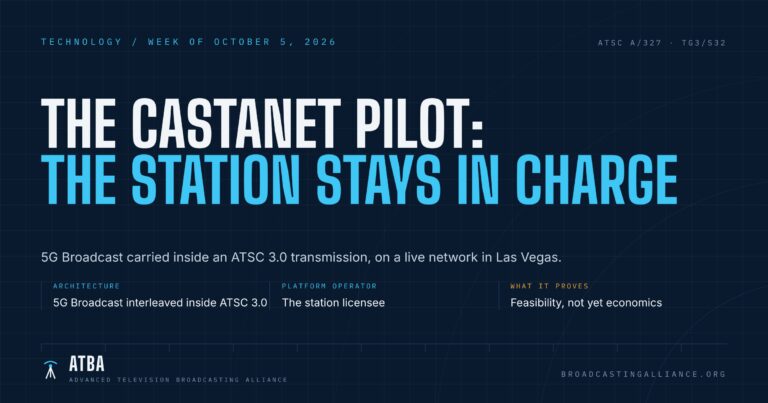
The standards work is finished. ATSC completed it as an amendment to Recommended Practice A/327, which is a recommended practice rather than a mandatory transmission standard. It describes how ATSC 3.0 and a second system, including LTE-based 5G Broadcast, can share a single television channel through time-domain multiplexing. Castanet launched a pilot in Las Vegas in April 2026 running both together. That is deployed capability, not a concept, though A/327 does not by itself amend the FCC’s rules or settle every authorization question for routine licensed operation.
We also support finishing the ATSC 3.0 transition on a definite schedule. LPTV does not need simulcast relief to move. Section 74.782 permits an LPTV or translator station to convert directly to 3.0 without simulcasting, but not by simply throwing a switch: § 74.782(g)(2) requires an FCC Form 2100 application and Commission approval before conversion, § 74.782(g)(3) treats it as a streamlined license modification when nothing else about the facility changes, and the station must run daily on-air consumer education announcements for 30 days before the 1.0 signal ends. What our members need is timing certainty, including when Class A stations get relief from the simulcast obligation in Section 73.6029.
That position keeps the three things our members have to hold: spectrum, distribution, and revenue.
What this means for your station
Do not plan to file comments in 25-168. That window closed in July 2025. The proceeding is pending and permit-but-disclose, so a licensee who wants to be heard there should work with communications counsel on a late or supplemental filing, or on a staff meeting made under the ex parte disclosure rules.
The August petition is the live one, and it is early. Watch for a public notice seeking comment on it, and be ready when it appears.
Then write something short in your own words. A declaration from an actual licensee does more for the record than a long brief from someone who has never signed an FCC Form 2100. Say what you operate, what you have put into the facility, and what you believe a standalone cellular authorization would do to the value of your license. If that is not realistic this fall, send ATBA the numbers from your own build and we will carry them. The industry that shows up in the record is the industry the rules get written for.