Why ATBA Opposes the Push to Open LPTV Channels to 5G Broadcast
By Lee Allen Miller, Executive Director, Advanced Television Broadcasting Alliance
On May 12, 2026, the LPTV Broadcasters Association, through its chairman and founder Frank Copsidas, sent an open letter to FCC Chairman Brendan Carr asking the Commission to formally recognize the 3GPP 5G Broadcast standard – Releases 16 through 19, including Bands 112 and 113 – as a voluntary transmission option under Part 74 for Low Power Television stations. The letter asks the FCC to fast-track a Notice of Proposed Rulemaking in response to HC2 Broadcasting’s petition in MB Docket 25-168, and to move toward an order “without delay.” Two days later, on May 14, Mark Aitken, Senior Vice President at Sinclair Broadcast Group and President of ONE Media, published an op-ed in TV Technology titled “Stop the False Choice – 5G Broadcast Can Ride Inside ATSC 3.0, and We Can Deploy Now.” Copsidas responded with a public reply the following day. The exchange has now made the underlying dispute explicit, and the public record is clearer than it has been at any prior point in this debate.
I want to be direct with our members and with the broader broadcast industry about where the Advanced Television Broadcasting Alliance stands on this.
The issue is not innovation. It is control.
ATBA supports innovation. We support mobile delivery, datacasting, advanced emergency information, new LPTV business models, and a modernized broadcast platform capable of serving fixed, portable, and mobile users. That is exactly why ATBA supports ATSC 3.0.
But ATBA does not support asking the FCC to authorize 3GPP 5G Broadcast as a standalone Part 74 transmission standard on LPTV spectrum. That is the wrong policy path, at the wrong time, for the wrong reason.
LPTVBA presents this as technology freedom. ATBA sees a spectrum trap. The word voluntary does a great deal of work in the LPTVBA request – but voluntary does not mean harmless. A voluntary authorization can still create a regulatory precedent, fragment an industry, weaken an ongoing transition, and give future spectrum-reallocation advocates exactly the argument they have been waiting to make. If LPTV channels are authorized to operate a 3GPP cellular standard, the next question will not be whether LPTV is innovative. It will be whether LPTV still needs to hold the spectrum at all.
ATBA’s position is straightforward: 5G Broadcast capability should be explored within a broadcaster-controlled ATSC 3.0 architecture, not through a standalone 3GPP transmission authorization that recasts LPTV spectrum as cellular-compatible spectrum. Innovation within ATSC 3.0, not regulatory displacement around it.
This piece lays out, in detail, why ATBA is taking that position, what we have already told the FCC in our formal filings, and what we believe LPTV operators need to understand before this debate goes any further.
What the LPTVBA Letter Actually Asks For
The letter frames itself as a deregulatory, pro-innovation appeal. It draws explicit parallels to Chairman Carr’s “Delete, Delete, Delete” initiative and to President Trump’s January 2025 Executive Order on regulatory reform. It positions 5G Broadcast as the natural successor to ATSC 3.0 – a “global standard” already deployed in Europe and Asia, ready to deliver linear television, live events, datacasting, and sub-half-second emergency alerting directly to 5G and 6G smartphones without additional hardware.
The asks are specific. Recognize 3GPP 5G Broadcast as a voluntary Part 74 transmission standard. Fast-track an NPRM. Move toward an order without delay. Treat LPTV as the “perfect proving ground” for the technology.
The letter names Qualcomm, Ericsson, XGN Global, and X1 Mobile as the American companies leading global 5G Broadcast trials. It cites the July 2025 Central Texas floods as a use case for 5G Broadcast emergency alerting. It claims that ATSC 3.0 reaches “only a tiny percentage of the devices Americans actually use” – a characterization worth examining against the FCC’s own findings.
On the surface, it reads as a forward-looking deregulatory pitch. Read carefully, it is something else.
The History LPTV Operators Cannot Afford to Forget
In 2012, a payroll tax bill gave the FCC authority to conduct the incentive auction. In 2017, that auction concluded. Approximately 84 megahertz of broadcast television spectrum was reallocated to wireless carriers. The repack that followed reorganized what remained of the broadcast band into a smaller footprint, and LPTV stations – which are licensed on a secondary basis – bore the brunt of the displacement.
Hundreds of LPTV stations went dark. Translators were dislocated. Operators spent millions in unreimbursed costs to find new channels, file displacement applications, or simply shut down. The repack reimbursement fund Congress eventually authorized helped full-power and Class A stations. Many primary LPTV stations were not eligible at all in the original framework, and the partial relief that came later did not undo the operational and financial damage already done.
That is the relevant history. When Congress and the FCC have been asked to choose between preserving broadcast capacity and reallocating spectrum for mobile broadband, LPTV has too often been treated as the most expendable part of the broadcast ecosystem. Our spectrum has already been treated as a reserve account that wireless interests can draw against when they decide they want more.
This is not paranoia. It is precedent. And it is the precedent that should sit at the front of every LPTV operator’s mind when reading a letter that asks the Commission to authorize a 3GPP cellular standard on LPTV channels.
The Argument We Make Their Argument For Them
Here is what concerns me most about the LPTVBA position, and what I want every operator to think through carefully.
The wireless industry’s longstanding argument for reallocating broadcast spectrum has always rested on a single premise: that broadcast spectrum is underutilized, that the technology occupying it is dated, and that consumers receive content through cellular networks rather than over-the-air television. The carriers do not need to make that argument from scratch anymore. Studies are written. White papers are filed. Lobbying organizations stand ready.
What the carriers have not had, until now, is a request from LPTV operators themselves asking the FCC to authorize a 3GPP cellular standard – the very standard the carriers use – on our channels.
Think carefully about what that does. If the FCC grants the LPTVBA request and authorizes 5G Broadcast on LPTV spectrum, the next question from the wireless industry will be obvious. If LPTV channels can run a 3GPP standard, and if 3GPP standards are the global cellular norm, why is this spectrum allocated to broadcasting at all? Why not reallocate it to licensees who operate 3GPP networks at scale, with established device ecosystems, established billing relationships, and established carrier infrastructure?
We will have answered that question for them. We will have made their argument. And we will have made it in a formal docket, on the record, signed by an organization claiming to speak for LPTV broadcasters.
The LPTVBA letter calls 5G Broadcast a way to give LPTV “the same tech freedom as cellular.” I would put it differently. It is a way to invite cellular into our spectrum and then watch the FCC decide that cellular’s licensees should hold it.
Who Actually Benefits
The letter is candid about which companies are driving 5G Broadcast development. Qualcomm. Ericsson. Global handset manufacturers. XGN Global. X1 Mobile. These are not LPTV companies. They are not in the business of preserving over-the-air local broadcasting. They are in the business of selling chipsets, network equipment, and devices into cellular ecosystems.
What the letter does not fully explain is the commercial ecosystem behind the request. Two of the three American companies it names – XGN Global and X1 Mobile – are companies of which Frank Copsidas, the letter’s signer, is the chief executive officer. The petition the letter asks the FCC to fast-track, MB Docket 25-168, was filed by HC2 Broadcasting – a co-founder, alongside Copsidas’s XGN, of the 5G Broadcast Collective, an industry advocacy organization that Copsidas also founded and serves as president. These relationships are a matter of public record. They are not disclosed in the letter.
Their interest in 5G Broadcast is real and rational. A unified 3GPP standard that operates across cellular and broadcast bands expands their addressable market and reduces the engineering cost of supporting multiple standards. It is good business for them.
It is a different question entirely whether it is good business for LPTV.
The business distinction is fundamental. ATSC 3.0 lets an LPTV licensee become a platform operator – video, datacasting, local services, emergency information, advertising, applications, and data distribution, all under broadcaster control. Standalone 5G Broadcast risks reducing that same licensee to a spectrum host inside a cellular-defined ecosystem – a wholesale carrier of someone else’s service architecture, on hardware certified by someone else, addressed to devices controlled by someone else.
ATSC 3.0 was developed with broadcasters at the center of the design. The standard was built to give broadcasters control of their distribution, their data, their advertising, and their relationship with viewers. It was authorized by the FCC after years of advocacy by broadcasters themselves. The more than 14 million ATSC 3.0-capable receivers already in American homes were sold because broadcasters and the consumer electronics industry agreed on a standard that broadcasters could operate on their own terms.
5G Broadcast, as a standalone Part 74 transmission standard, is a different proposition. It runs on the cellular industry’s standards, evolves on the cellular industry’s release cycle, and depends on the cellular industry’s device ecosystem. A broadcaster running standalone 5G Broadcast is, in a meaningful sense, a participant in someone else’s network architecture.
That is not inherently bad. Hybrid approaches that combine ATSC 3.0 and 5G Broadcast may have a place in the long-term broadcast roadmap, and serious engineers are already doing exactly that work. But there is a vast difference between broadcaster-led integration of 5G Broadcast inside ATSC 3.0 and a regulatory push to install a cellular standard as a standalone authorized LPTV transmission mode.
The first preserves broadcaster control. The second hands the steering wheel to companies whose interests are not aligned with ours.
The ATSC 3.0 Transition Is Working
The LPTVBA letter describes ATSC 3.0 as a standard that “remains a voluntary, non-global standard” reaching “only a tiny percentage of the devices Americans actually use.” That characterization does not match what the FCC itself has found.
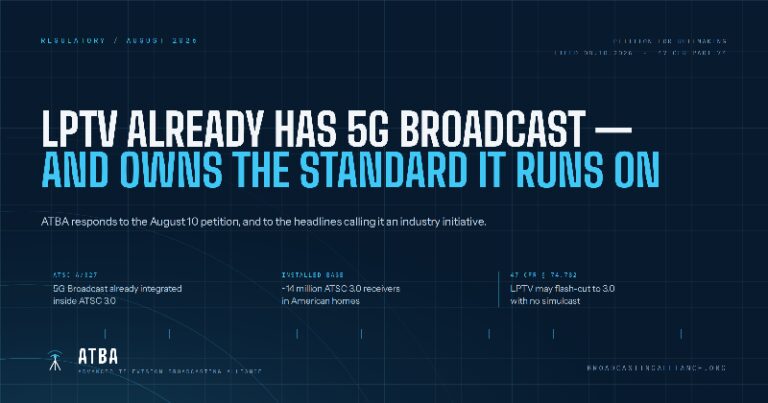
In the Fifth Further Notice of Proposed Rulemaking released October 29, 2025, the Commission documented that full-power NextGen TV service had launched in more than 80 markets, reaching more than 70 percent of the American population, with more than 14 million ATSC 3.0-capable sets and 300,000 external converters sold through 2024. ATBA’s own January 20, 2026 comments in that docket confirmed these figures and laid out a path for completing the transition.
That is not a failed standard. That is a standard in mid-deployment, with the infrastructure in place, the receivers in homes, and the regulatory framework already approved. What ATSC 3.0 needs to reach critical mass is not a competing transmission standard authorized on the same channels. What it needs is the policy support to finish the transition – and that is precisely what ATBA has been asking the FCC to provide.
A Word About the Texas Floods
The LPTVBA letter invokes the July 2025 Central Texas floods as a use case for 5G Broadcast, asking readers to imagine “the potential outcome” if 5G Broadcast had been delivering “reliable public alerts and encrypted first-responder channels” to mobile phones in the Hill Country that night.
I live in Texas. I watched that disaster unfold.
The Central Texas floods struck the Hill Country – Kerrville, the Guadalupe River corridor, Camp Mystic – overnight on the Fourth of July weekend. The tragedy was real, the loss devastating, and the questions that emerged from it deserve careful answers, not marketing claims.
The Hill Country tragedy should not be used as a shortcut around the hard questions: What transmitters would have covered those canyons? What consumer devices would have contained enabled 5G Broadcast receivers? What alerting authority would have triggered the service? What first-responder agencies would have integrated it? What spectrum, antennas, power, and certified equipment would have been in place that July night? Without answers to those questions, the flood example is not evidence. It is aspiration dressed as proof.
The serious lesson from a disaster like the Hill Country floods is that emergency communications depend on layered resilience – over-the-air broadcast, land mobile radio, FirstNet, local alerting systems, weather radios, sirens where deployed, and trained public safety procedures. ATSC 3.0 Advanced Emergency Information is directly relevant here. It can deliver rich, geo-targeted emergency content over broadcast spectrum without requiring an active cellular connection. The right policy response is to accelerate a modern broadcast platform that can serve the public when unicast networks are congested, damaged, or unavailable. It is not to move LPTV into a standalone cellular standard whose value proposition depends on the same mobile networks that fail in disasters.
Texans deserve better than to have their loss invoked in support of a regulatory petition that has not done the work of showing what would actually have changed the outcome. So does the FCC.
The European Comparison Doesn’t Translate
The LPTVBA letter argues that “Europe and Asia are already deploying 5G Broadcast” and that the United States is “lag[ging] behind the world.” The implication is that the European deployment proves the technology is ready and that the US should follow.
The implication does not hold up. European 5G Broadcast and US LPTV operate in fundamentally different ecosystems.
In Europe, 5G Broadcast is being deployed by national broadcast infrastructure operators – TDF in France, Media Broadcast in Germany, RAI in Italy, Emitel in Poland, CRA in the Czech Republic, BTCY in Belgium. Many of these are state-aligned or quasi-public entities with public-service mandates, partial government ownership, or longstanding regulatory coordination roles. They operate centralized national transmission networks. They have the political backing to deploy infrastructure as a coordinated public initiative.
US LPTV is the structural opposite. LPTV is a service of more than 1,800 stations licensed on a secondary basis, owned by hundreds of independent operators – religious broadcasters, community stations, small for-profit businesses. There is no centralized national network. There is no public-service mandate. There is no shared infrastructure. Each operator is responsible for its own equipment, its own carriage agreements, and its own spectrum defense.
The spectrum environments are also different. European 5G Broadcast is being deployed in coordination with cellular allocations under regulatory frameworks that European authorities have spent two decades harmonizing. The US broadcast band is structurally separated from cellular allocations, and the 2017 incentive auction has already established the precedent that broadcast spectrum can be transferred to wireless when the political winds blow that direction.
The operator economics are different. European public broadcasters do not live or die by advertising revenue. US LPTV operators do. Adopting a transmission standard whose value proposition is “delivery to mobile phones” requires a monetization path in a mobile advertising market controlled by Google, Meta, and the cellular carriers themselves – parties that have no incentive to make that monetization easy for an LPTV operator.
Citing European deployment as a precedent for US LPTV adoption is like citing the French rail system as a precedent for American freight logistics. The technology may be the same; the ecosystems are not. What works in a coordinated, state-backed, publicly-mandated European broadcasting environment is not a roadmap that LPTV operators in Texas, Tennessee, or Tallahassee can simply pick up and follow.
What ATBA Has Already Filed
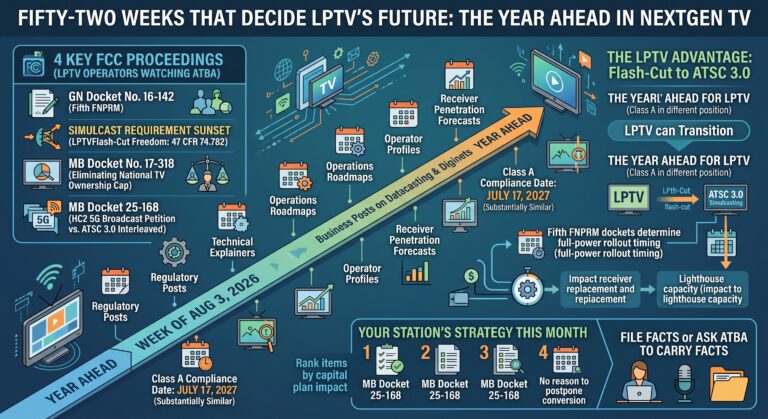
On January 20, 2026, ATBA submitted formal comments to the Commission in GN Docket No. 16-142, the docket governing the ATSC 3.0 transition. Our position is on the record. It is consistent. It is the position the Alliance has held for years.
We support eliminating the simulcasting requirement so that full-power stations and LPTV stations can transition fully to ATSC 3.0 without being forced to maintain dual signals indefinitely. We documented case studies – Gray Television’s WNXG-LD launch in Tallahassee, Public Media Venture Group’s W35DZ-D in Cookeville, and the 14 channel 6 stations that used 3.0 to add full audiovisual service – showing that LPTV’s “flash cut” flexibility under Section 74.782(c) is already producing real innovation.
We support FCC test markets to accelerate consumer adoption of ATSC 3.0, with explicit protections for LPTV participation and a clear statement that participation does not obligate a station to operate in 3.0 indefinitely.
We have asked the Commission to clarify that the All-Channel Receiver Act of 1962 requires the inclusion of ATSC 3.0 tuners in new television sets. This is the single most consequential step the FCC can take to accelerate the transition. The legal authority is already there in 47 U.S.C. § 303(s). The FCC’s own 2017 carve-out exempting 3.0 from the universal tuner requirement was justified on the assumption that broadcasters would transmit ATSC 1.0 signals indefinitely. That assumption no longer holds, and the carve-out should be revisited.
We have asked the Commission to establish a firm sunset deadline for ATSC 1.0 service for full-power stations, while preserving LPTV flexibility to transition on a timeline that fits each operator’s business. The NAB has already gone on the record supporting that approach for LPTV. So has Scripps.
We have asked the Commission to preserve the existing requirement that broadcasters transmit at least one free over-the-air video program signal at no direct charge to viewers, in keeping with broadcasting’s fundamental public-interest mission.
That is a complete, coherent transition strategy. It keeps broadcasters in control. It uses regulatory authority the FCC already has. It builds on infrastructure already deployed. And it does not invite the cellular industry into our spectrum.
The Aitken / Castanet / Fotheringham Question
One argument the LPTVBA letter makes deserves a direct response. The letter notes that ATSC 3.0 proponents who “until recently, publicly viewed 5G Broadcast as an existential threat to ATSC 3.0” have begun “embracing 5G Broadcast as a value-add” – citing reported work by Castanet, led by 5G Broadcast pioneer Vern Fotheringham, and recent comments by Mark Aitken at One Media.
This framing rewrites recent history. The public record now contradicts it directly.
The Castanet work does not prove the case for standalone 5G Broadcast. It proves the opposite: that ATSC 3.0 is flexible enough to host 5G Broadcast functionality while preserving broadcaster control of the transmission, spectrum, and service architecture. TV Technology’s reporting on the Las Vegas pilot describes the architecture explicitly – Castanet uses ATSC 3.0 as the transport layer for 5G Broadcast, in alignment with current FCC regulations and industry standards. That is broadcaster-led integration. It is not a substitute Part 74 transmission standard. It is a vindication of ATSC 3.0 as the platform.
Start with the standards body itself. On March 5, 2026, TV Technology published a Q&A with Luiz Fausto, Vice President of Standards Development at the Advanced Television Systems Committee – the organization that owns and maintains the ATSC 3.0 standard. The interview documented work that ATSC TG3/S32, the Specialist Group on the Physical Layer, had completed on interleaving 5G Broadcast waveforms inside ATSC 3.0 transmissions. The work began in 2024. It progressed through testing, contributions, and drafting. It produced an amendment to ATSC Recommended Practice A/327, which provides guidelines for the ATSC 3.0 physical layer protocol. The amendment was approved in TG3 ballot and was under ATSC membership ballot through March 10, 2026, with publication expected immediately after.
Fausto’s description of how this work originated is worth quoting carefully. Asked whether the technical group included representation from the wireless community, Fausto answered that yes, “some ATSC members, including one deeply involved in the wireless community, proposed that ATSC test and, if necessary, clarifying the use of interleaving between ATSC 3.0 and 5G Broadcast, and participated throughout the process.” In other words: the 5G Broadcast community came to the standards body. ATSC tested the interleaving approach. ATSC documented it. ATSC standardized it as an extension of ATSC 3.0. No normative changes to ATSC 3.0 were required – the capability for time-domain channel sharing was already built into the standard from the outset.
Fausto’s closing takeaway frames the institutional position cleanly: “ATSC continues to innovate beyond today’s deployments, extending the value of ATSC technology to broader IP-centric and broadcast-to-everything use cases – while maintaining a deliberate roadmap that protects existing investments and enables future growth.” That is the standards body’s published view of ATSC 3.0’s role in the 5G Broadcast question. The standard is the foundation. 5G Broadcast is an interleavable capability inside it. The roadmap protects existing investments rather than discarding them.
Two months after the Fausto interview, on May 14, 2026, Mark Aitken published an op-ed in TV Technology titled “Stop the False Choice – 5G Broadcast Can Ride Inside ATSC 3.0, and We Can Deploy Now.” The piece is not the surrender the LPTVBA letter suggests. It is the opposite – a detailed technical and policy case that ATSC 3.0 is the foundational broadcast layer and that 5G Broadcast operates as a time-multiplexed payload inside it.
Aitken writes that ATSC 3.0 “was designed to carry IP services to fixed, portable, and mobile receivers – and mobile-grade ATSC 3.0 receiver subsystems exist today.” He documents that “the technical path to carry LTE-based 5G Broadcast windows inside an ATSC 3.0 RF channel is now documented and repeatable.” He lays out the three engineering parameters that govern the time-multiplexing – the 5G Broadcast CAS muting cycle, the ATSC frame duration, and the ATSC bootstrap timing – and concludes that “the challenge is coordination, not physics.”
Aitken’s three-phase deployment plan is unambiguous about which standard is the foundation and which is the additive capability. Phase 1 ships ATSC 3.0 datacasting at scale now. Phase 2 publishes a coexistence profile that defines how 5G Broadcast windows fit inside ATSC 3.0 RF channels. Phase 3 expands handheld device pathways using India-led scale for ATSC 3.0-based Direct-to-Mobile. In every phase, ATSC 3.0 is the broadcast layer.
What Aitken describes on paper, I have seen operating in person. At NAB 2026 in April, I visited the Castanet booth on the show floor, where Vern Fotheringham was demonstrating a working 5G Broadcast signal operating within an ATSC 3.0 transmission. Not a slide. Not a simulation. A live demonstration of the architecture Aitken’s op-ed now documents – 5G Broadcast payload windows time-multiplexed inside an ATSC 3.0 RF channel, with the broadcaster retaining control of the transmission. The Copsidas reply dismisses Castanet’s work as a “small-scale pilot” and a “lab effort.” I will say plainly that what I observed at NAB 2026 was neither. It was a functioning system, shown publicly to the broadcast industry, doing exactly what the LPTVBA reply claims cannot yet be done.
Those of us who attended LPTV Day at NAB in 2025 will remember Vern Fotheringham and Mark Aitken on the same stage in the Westgate, in the Signal Clash session moderated by Dr. Joshua Weiss. The session was billed as a head-to-head debate. What actually unfolded was something more interesting, and now, in light of Aitken’s May 14 op-ed, more consequential. Vern and Mark were already largely in agreement that the path forward involved 5G Broadcast operating within the ATSC 3.0 stream – not as a competing transmission standard on the same spectrum, but as a capability layered inside an ATSC 3.0 signal. The “clash” promised in the session title turned out to be a convergence. Aitken’s op-ed makes that convergence explicit and public.
Copsidas’s reply to the Aitken op-ed, published the following day, contains a sentence that operators should read carefully. He writes that “the use of ATSC 3.0 in Castanet is essentially a bandaid solution until 5G Broadcast is fully licensed and available.”
That sentence is the LPTVBA agenda stated plainly. The May 12 letter to Chairman Carr framed the petition as a request for 5G Broadcast as a “voluntary transmission option.” Voluntary suggests coexistence – operators choosing between standards based on what fits their business. Copsidas’s reply contradicts that framing. ATSC 3.0 is not a peer standard in the LPTVBA’s view. It is a “bandaid” to be discarded once 5G Broadcast is “fully licensed and available.” The petition is not a coexistence request. It is a replacement request, now stated openly in the trade press.
That distinction matters enormously for LPTV operators evaluating whether to support the petition. If you have invested in ATSC 3.0 infrastructure, the LPTVBA’s published position is that your investment is a temporary patch on the way to its replacement. If you have not yet invested, the LPTVBA’s published position tells you what the destination is.
A final note on the Copsidas reply. The piece refers to its author as “SuperFrank,” dismisses Aitken’s documented engineering work as a “sad technical patch,” and characterizes the ATSC 3.0 community as engaged in “rearguard actions” born of “exhaustion.” Name-calling is not advocacy. The FCC will not be persuaded by it. LPTV operators evaluating which voice to follow on this question should weigh whose argument relies on engineering documentation published in TV Technology, and whose relies on nicknames.
The Real Risks
Let me lay out, plainly, what ATBA believes the LPTV industry stands to lose if the LPTVBA petition succeeds. The risks below are ordered from structural to economic to political – because that is the order in which they unfold.
Spectrum reallocation. Once a 3GPP cellular standard is authorized on LPTV channels, the wireless industry’s long-standing argument that broadcast spectrum is underutilized acquires new force. The next reallocation conversation will not be hypothetical. It will be active.
Loss of broadcaster control. ATSC 3.0 is broadcaster-controlled at the physical layer, the transport layer, and the application layer. Standalone 5G Broadcast operates within the 3GPP ecosystem, which is governed by the cellular industry’s standards bodies and dominated by carrier interests. Broadcasters operating in that ecosystem are not in control of their roadmap.
Device dependency. ATSC 3.0 receivers are sold into a market the consumer electronics industry can serve directly. 5G Broadcast reception on smartphones depends on chipset support, carrier-controlled software environments, and device certification regimes that broadcasters do not control.
Regulatory precedent. Once the FCC authorizes a non-ATSC, 3GPP-based mode for LPTV, the precedent may not stay limited to “voluntary” LPTV experimentation. It may become the basis for broader proceedings on whether the broadcast allocation itself should be made more “flexible.” This is the bridge between today’s technical decision and tomorrow’s spectrum threat.
Loss of the ATSC 3.0 investment. Operators who have already invested in 3.0 infrastructure, station modifications, and business model development should not have their investment undermined by a parallel regulatory track that authorizes a competing standard before 3.0 has reached scale.
Fragmentation of LPTV advocacy. A divided LPTV industry – with one association advocating for ATSC 3.0 transition support and another advocating for 5G Broadcast authorization – gives the FCC and Congress permission to do nothing for either side, or worse, to side with the wireless interests who benefit from broadcaster disunity.
Four Questions Every LPTV Operator Should Ask
Before supporting the LPTVBA petition, every LPTV operator should ask four questions. Who controls the standard my spectrum will run on? Who controls the device ecosystem my viewers or customers must use? Who controls the roadmap for how that technology evolves? And when the next spectrum reallocation effort comes – and it will come – who will be standing before the FCC and Congress to explain why my spectrum must remain broadcast spectrum?
ATBA’s answer is that ATSC 3.0 keeps those answers in broadcaster hands. A standalone 5G Broadcast authorization does not.
This is why ATBA opposes the push to open LPTV channels to standalone 5G Broadcast under Part 74. Not because 5G Broadcast is irrelevant. Not because mobile delivery is unimportant. Not because innovation should stop. We oppose it because the proposed regulatory path weakens the very thing LPTV operators must protect first: control of their own spectrum.
LPTV has already given up too much in prior spectrum battles. We should not make the next argument for the wireless industry ourselves.
A Final Word – to the Commission
This piece has been addressed primarily to LPTV operators, because it is their spectrum, their investment, and their future that is most directly at stake. But the decision does not rest with operators. It rests with the FCC.
So a closing word to the Commission, and to the policymakers who oversee it.
The LPTVBA letter asks the FCC to fast-track a rulemaking on the strength of a single premise – that authorizing 5G Broadcast as a standalone Part 74 transmission standard is a deregulatory, pro-innovation step that simply gives LPTV the freedom cellular already enjoys. Before the Commission acts on that premise, it is worth asking three questions.
Has the standards body been consulted? The Advanced Television Systems Committee has already done this work. It has tested 5G Broadcast interleaving within ATSC 3.0, documented it, and standardized it in an amendment to Recommended Practice A/327. The integration the petition treats as impossible without FCC action is finished, published, and available today – within ATSC 3.0, with broadcaster control intact.
Whose interests does the petition serve? The letter urging this action names XGN Global and X1 Mobile as American 5G Broadcast leaders without disclosing that its signer is the chief executive of both, and asks the FCC to fast-track a petition filed by a company that co-founded a 5G Broadcast advocacy organization with that same signer. These relationships are a matter of public record. They were not in the letter.
What is actually irreversible here? Spectrum decisions do not unwind. Once a 3GPP cellular standard is authorized on LPTV channels, the argument that this spectrum belongs with cellular licensees acquires a force it has never had before. The 2017 incentive auction showed how quickly broadcast spectrum moves when the policy rationale is in place. This petition would supply that rationale.
The issue is not whether 5G Broadcast has technical merit. The issue is who controls the spectrum, who controls the roadmap, and whether LPTV operators are being asked to trade ownership of their future for access to someone else’s ecosystem.
ATBA is not asking the Commission to oppose innovation. We are asking it to recognize that the innovation is already here, already standardized, and already broadcaster-controlled – and that the path the LPTVBA petition proposes is not the only path, not the consensus path, and not a path that can be reversed once taken.
Innovation is not the problem. Surrendering the architecture of our spectrum future is the problem.
ATBA supports innovation that strengthens broadcasters. We oppose regulatory shortcuts that turn LPTV spectrum into the wireless industry’s next acquisition target.
ATBA is not defending the past. It is defending broadcaster control of the future. We respectfully urge the Commission to choose the path that keeps that spectrum, and that future, in the hands of the broadcasters it was meant to serve.
Lee Allen Miller is Executive Director of the Advanced Television Broadcasting Alliance (ATBA), the trade association representing Low Power Television and over-the-top broadcasting interests. Operators interested in joining ATBA or contributing to its regulatory advocacy can contact info@broadcastingalliance.org.
SOURCES AND CITATIONS
ATBA Filings (GN Docket No. 16-142)
Every statement in this piece characterizing ATBA’s filed position is drawn from the formal Comments of Advanced Television Broadcasting Alliance, submitted to the Federal Communications Commission in GN Docket No. 16-142 on January 20, 2026, in response to the Commission’s Fifth Further Notice of Proposed Rulemaking (FCC 25-72, released October 29, 2025). Specific citations within the ATBA filing are as follows:
ATSC 3.0 deployment figures (more than 80 markets, 70%+ population reach, more than 14 million ATSC 3.0-capable sets, 300,000 external converters through 2024): Fifth FNPRM ¶¶ 1 & 29 n.103 (Oct. 29, 2025); ATBA Comments at 2.
Support for eliminating the simulcasting requirement: ATBA Comments Section II at 3-5.
Case studies (Gray Television’s WNXG-LD, PMVG’s W35DZ-D, 14 channel 6 stations): ATBA Comments at 3-4, nn.5-9.
LPTV “flash cut” flexibility (47 C.F.R. § 74.782(c)): ATBA Comments at 3 n.4.
Support for FCC test markets with voluntary LPTV participation: ATBA Comments Section III at 5-6.
All-Channel Receiver Act / ATSC 3.0 tuner inclusion (47 U.S.C. § 303(s)): ATBA Comments Section IV at 6-7, nn.11-16.
ATSC 1.0 sunset deadline for full-power, flexibility for LPTV: ATBA Comments Section V.A at 7-8, citing Letter from Lee Miller, ATBA to FCC (Sept. 3, 2025); NAB Petition at 17 (Feb. 26, 2025); Scripps Comments at 6 n.15 (May 7, 2025).
Preservation of free over-the-air video program requirement (47 C.F.R. § 73.724(b); § 74.790): ATBA Comments Section V.B at 8-9, nn.19-20.
Other Public-Record Sources
LPTVBA letter to Chairman Carr (May 12, 2026): Letter from Frank Copsidas, Chairman and Founder, LPTV Broadcasters Association, to Chairman Brendan Carr, FCC, filed in MB Docket No. 25-168.
ATSC standards body position on 5G Broadcast interleaving within ATSC 3.0: Phil Kurz, “Q&A: ATSC’s Luiz Fausto on Ensuring 5G Broadcast Delivery Via 3.0,” TV Technology (Mar. 5, 2026), available at tvtechnology.com; Amendment to ATSC Recommended Practice A/327 (Guidelines for the Physical Layer Protocol), under ATSC membership ballot through Mar. 10, 2026; work product of ATSC TG3/S32 (Specialist Group on the Physical Layer).
Mark Aitken op-ed (May 14, 2026): Mark Aitken, “Op-Ed: Stop the False Choice – 5G Broadcast Can Ride Inside ATSC 3.0, and We Can Deploy Now,” TV Technology (May 14, 2026), available at tvtechnology.com.
Frank Copsidas reply to Aitken op-ed (May 15, 2026): Frank Copsidas, “A Sympathetic Response to Mark Aitken’s Op-Ed,” LPTV Broadcasters Association newsletter (May 15, 2026).
HC2 Broadcasting petition for rulemaking: Petition for Rulemaking of HC2 Broadcasting, MB Docket No. 25-168 (2025).
Frank Copsidas’s roles at XGN Global, X1 Mobile, LPTV Broadcasters Association, 5G Broadcast Collective, and Intrigue TV: XGN Network LLC press releases (xgnglobal.com; xgn.network); IEEE Broadcast Technology Society speaker profile; Jeff Baumgartner, “Why low-power TV stations have high hopes for 5G Broadcast,” Light Reading (Apr. 10, 2025); George Winslow, “5G Broadcast Advocates Announce New Alliance,” TV Tech (Apr. 5, 2024).
Castanet hybrid ATSC 3.0 / 5G Broadcast pilot network: Castanet booth demonstration, NAB Show 2026, Las Vegas Convention Center (April 2026); TV Tech, “Castanet Launches Hybrid ATSC 3.0 and 5G Broadcast Internet Pilot Network in Vegas” (NAB 2026 coverage); LPTV Day at NAB 2025 Signal Clash session, Westgate Las Vegas, April 2025 (Vern Fotheringham and Mark Aitken; moderated by Dr. Joshua Weiss).
2017 incentive auction and broadcast spectrum repack: Middle Class Tax Relief and Job Creation Act of 2012, Pub. L. No. 112-96; Expanding the Economic and Innovation Opportunities of Spectrum Through Incentive Auctions, Report and Order, GN Docket No. 12-268, 29 FCC Rcd 6567 (2014).
European 5G Broadcast Strategic Task Force (TDF, Media Broadcast, RAI, Emitel, CRA, BTCY): RCR Wireless News, “R&S sees 5G Broadcast moving toward use in Europe by 2027” (Mar. 19, 2025); Rohde & Schwarz press releases on 5G Broadcast Strategic Task Force (5BSTF).
Filing Access
The complete text of ATBA’s January 20, 2026 Comments is available through the FCC’s Electronic Comment Filing System (ECFS) at fcc.gov/ecfs under GN Docket No. 16-142, or by contacting ATBA at info@broadcastingalliance.org.