In Las Vegas this spring, a working network carried 5G Broadcast traffic inside an ATSC 3.0 transmission, and the broadcaster never stopped being the one running the platform.
Standards fights are usually settled by lawyers and comment cycles. Occasionally they are settled by somebody turning on a transmitter. Castanet, the hybrid broadcast-broadband venture founded by Vern Fotheringham, launched a live pilot network in Las Vegas that put the central technical question in front of the industry in a form nobody could argue with: does 5G Broadcast need its own slice of broadcast spectrum, or can it ride inside ATSC 3.0 today?
The pilot answered it. It ran.
The Operator Behind the Pilot
Fotheringham is not a newcomer to convergence. His career runs through wireless infrastructure and broadband build-outs, and Castanet exists because he concluded that the terrestrial broadcast plant is an underused delivery asset for internet-style services rather than a legacy video business waiting to be retired.
That is a useful vantage point, and it is worth being precise about how we characterize it. His published position, as reflected in trade coverage of the Las Vegas deployment, is that hybrid broadcast-broadband service is commercially ready now and that ATSC 3.0 is the right transport under it. He is not arguing that 5G Broadcast is unimportant. He is arguing that it does not require a separate authorization on broadcast spectrum to be useful, because there is already a place to put it.
We paraphrase deliberately here rather than putting words in his mouth. Operators who want the argument in his own framing should read the coverage of the pilot directly.
What the Pilot Actually Does
Strip out the branding and the architecture is straightforward. ATSC 3.0, the standard sold to consumers as NextGen TV, is an internet protocol transmission system. Everything it carries is IP. Video is one payload among several, alongside data files, software updates, emergency information, and precision timing.
Because the transport is IP, the pilot can use ATSC 3.0 as a one-to-many downstream pipe for broadband-style delivery: content pushed out to edge caches, devices, and premises across the coverage area without touching a cellular network or a fiber drop. The 5G Broadcast waveform is carried within that ATSC 3.0 transmission rather than alongside it on separate spectrum.
The key word is “within.” The ATSC TG3/S32 group standardized exactly this through an amendment to Recommended Practice A/327, the guidelines governing the ATSC 3.0 physical layer. The physical layer is the part of the standard that decides how bits get modulated onto the radio wave. The amendment established that a 5G Broadcast waveform can be interleaved into that layer without destabilizing the rest of the standard.
Castanet took that paper result and made it a running network in a real market with real interference and real receivers. Anyone who has commissioned a transmitter knows the distance between a standards document and a signal that behaves in the field. Multipath does not read recommended practices. Neither do consumer tuners.
Why Interleaving Is the Whole Argument
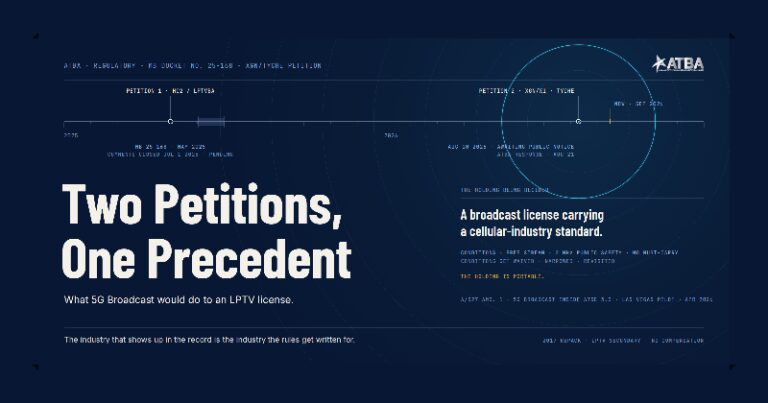
For two years the industry has been told it faces a choice. Stay with ATSC 3.0 and cede the mobile future, or authorize 3GPP 5G Broadcast as a standalone transmission standard on LPTV spectrum, which is the relief sought in HC2 Broadcasting’s petition, MB Docket 25-168, and now in the XGN/X1 Mobile and Tyche Media petition the Commission put out for comment in MB Docket 26-263.
Mark Aitken of Sinclair and ONE Media has called that framing a false choice in a widely read op-ed, on the grounds that the interleaved path is available and deployable now. The Castanet pilot is the empirical version of that argument. You cannot maintain that interleaving is theoretical when a commercial-ready network in Las Vegas is doing it.
That reframes the petition. If the technical capability already exists inside the broadcast standard, then standalone authorization is not solving a technical problem. It is changing who holds the platform.
The Business Question Underneath the Engineering
This is the part LPTV owners should care about most, and it has nothing to do with modulation schemes.
Under the interleaved architecture, the broadcaster remains the platform operator. The station licensee controls the multiplex, decides how capacity is allocated between video services and data services, sets the terms with the parties buying that capacity, and keeps the customer relationship. Whatever revenue the data side generates arrives as the station’s revenue, not as a fee paid to the station by whoever actually runs the network.
Under standalone authorization on broadcast spectrum, that relationship is open for renegotiation. A cellular standard licensed onto the band brings with it a set of commercial expectations about who operates the network and who resells access to it. The station can end up as a site host rather than a platform owner. Site hosts do not capture the margin, and they do not control their own distribution.
The distinction shows up in ordinary contract language. A capacity lease written by a broadcaster reads like a carriage agreement: so many megabits per second, for so many hours, at a rate the station sets, terminable when the term ends. An arrangement written around a carrier standard tends to read like a network access agreement, with the operator of the network setting the technical parameters and the licensee accepting a share. Both put money on the table. Only one leaves the station able to change its mind in three years.
ATBA’s three non-negotiables for our members are spectrum, distribution, and revenue. The Castanet architecture keeps all three with the licensee. That is the reason we point to it.
What a Pilot Proves, and What It Does Not
Honesty about scope matters, because our readers have been oversold before.
A pilot proves feasibility, not economics. It demonstrates that the waveforms coexist, that receivers behave, and that the service can be stood up with commercially available gear. It does not tell a two-station operator in a mid-sized market what the payback period looks like on a gateway and exciter upgrade, and it does not establish that data customers will materialize at a price that clears the capital cost.
Those questions remain open across the whole datacasting category. BIA Advisory Services projected in 2021 that ATSC 3.0 non-core datacasting could reach $10.7 billion annually by 2030. That is a projection about the end of this decade, not revenue anyone is banking today, and it should be read as a market thesis rather than a business plan.
What the pilot does settle is the narrower question that the FCC proceeding turns on. The technical predicate for standalone authorization was that interleaving is not a practical option. It is a practical option. It is running.
What This Means for Your Station
Do three things with this.
If you are evaluating transmission gear this budget cycle, ask vendors directly what their roadmap is for A/327 interleaving support and get the answer in writing. Software-defined exciters and gateways that can be updated toward the amendment are worth a premium over fixed-function hardware that cannot.
If you are being approached about a data or connectivity partnership, read the term sheet for one thing above all others: who is the platform operator. Capacity leases where the station sets the terms and collects the revenue are a different business from arrangements where the station provides a tower and a license and receives a check.
And if you attend a trade show where hybrid delivery is being demonstrated, get into the room and look at the equipment rack. The Las Vegas pilot moved this debate from argument to evidence. Operators who have seen the evidence firsthand are the ones whose comments in the docket carry the most weight, because they are describing something they watched work. Comments in MB Docket 26-263 are due October 19, and reply comments are due November 18.
Take the next step: Interested in taking part in a pilot or exploring similar technology? Contact ATBA at info@broadcastingalliance.org and we’ll connect you with industry partners.