ATBA responds to the August 10 petition, and to the headlines calling it an industry initiative
On August 10, 2026, XGN / X1 Mobile and Tyche Media LLC petitioned the Federal Communications Commission to amend Part 74 so Low Power Television stations could voluntarily transmit using the 3GPP 5G Broadcast standard as an alternative to ATSC 1.0 or ATSC 3.0.
Two things need saying. The first is a correction. The second is the part we’d rather spend our words on: what LPTV operators can do right now, what it costs, and what it pays.
Setting the record straight
TV Technology ran the story under the headline “LPTV Advocates Petition FCC for Voluntary 5G Broadcasts.” Other outlets used similar framing. It reads as though the low power industry went to the Commission together. We didn’t.
This petition was filed by two companies. ATBA is not a party. The LPTV Broadcasters Association is not a party. The stations behind it are a very small fraction of the more than 1,800 low power and Class A licensees in the United States, and they’re under common ownership and control.
Any licensee is entitled to file at the Commission, and we have no interest in a fight over personalities. But a filing from a handful of commonly controlled stations is being read by policymakers as an industry position, and that record needs correcting — for our members first, and for the people at the Commission reading the same coverage.
What the petition proposes
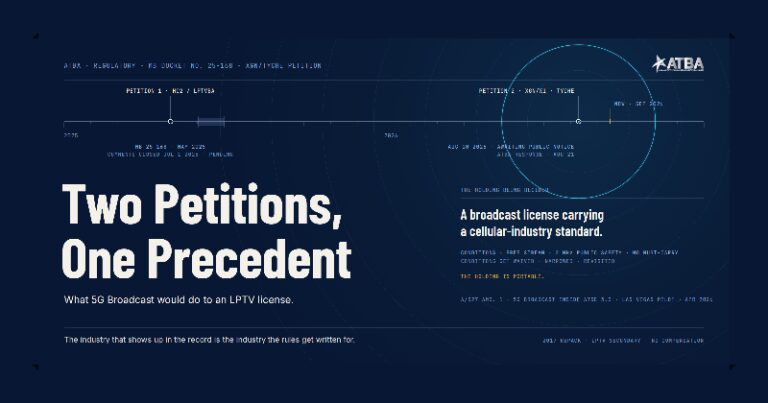
A station electing 5G Broadcast would carry at least one linear free-to-air stream at a minimum of 720p, devote a minimum average of 50 percent of its remaining 6 MHz capacity to public safety applications (never less than 2 MHz), and would be ineligible if it qualifies for mandatory carriage rights. The petitioners cite experimental operation at Tyche Media’s WCRN-LD in Boston, deployment costs as low as $25,000, and a commitment to build a network reaching more than 50 million people within 24 months of authorization.
They’re careful to distinguish their filing from HC2 Broadcasting Holdings’ pending proposal in MB Docket No. 25-168, which seeks exclusive datacasting with no linear obligation and no reserved public safety capacity. That distinction is real and we credit it. Preserving a free, high-quality linear stream beats abandoning over-the-air television altogether.
ATBA is not against 5G Broadcast
Let’s be plain, because the coverage has flattened this into a technology fight and it isn’t one.
ATBA has no objection to 5G Broadcast as a delivery method. We think broadcasters should be able to use it. The disagreement is about the container it arrives in.
The Advanced Television Systems Committee has already finished the work of integrating 5G Broadcast with ATSC 3.0, published as an amendment to Recommended Practice A/327. The capability this petition asks the Commission to authorize as a separate standard already exists inside a standard American broadcasters govern, on spectrum American broadcasters hold, in a framework the Commission has already approved.
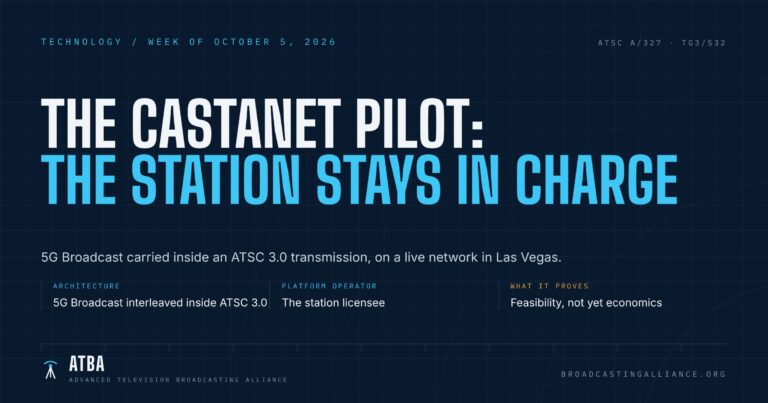
And hybrid operation isn’t a whiteboard exercise. In April 2026 Castanet launched a pilot network in Las Vegas running ATSC 3.0 and 5G Broadcast together – with Major Market Broadcasting and Diya TV, using ATSC 3.0 as the transport layer. The two standards already coexist on American air, under a broadcast license, on broadcast spectrum. Nobody needed a rulemaking to do it.
So the question isn’t whether LPTV gets 5G Broadcast. It’s whether we get it as a guest in someone else’s ecosystem or as the owner of our own.
What ATSC 3.0 pays for today
The revenue side is already turning over, and that’s the more interesting argument.
Start with the audience. Roughly 14 million ATSC 3.0 receivers are in American homes, with service in more than 90 markets covering upwards of 70 percent of the population. A station that lights up ATSC 3.0 tomorrow has viewers tomorrow. A station that lights up 5G Broadcast in the United States tomorrow transmits to essentially no domestic receivers. Commercial handsets with native reception are targeted for Europe on Band 113 in 2027.
Then look at datacasting, which now has actual buyers. EdgeBeam Wireless – the joint venture of E.W. Scripps, Gray Media, Nexstar and Sinclair – has moved from pre-revenue to its first paying customer, selling real-time kinematic GPS correction services through Digital Mapping Group. Sinclair’s Broadspan is chasing the same market. These are national data businesses being built on broadcast spectrum, and what they need is coverage. Coverage is what LPTV has, in places the big four do not.
The Broadcast Positioning System is the one our members should watch closest. BPS uses ATSC 3.0 to deliver a terrestrial timing and positioning signal that works when GPS doesn’t. It makes a broadcast license part of the country’s critical infrastructure, which is a far better answer to give a Congressional staffer asking why you should keep your channel. Only broadcasters can make that argument, and only on a broadcast standard.
ATSC 3.0 also makes local ad inventory measurable and targetable in ways ATSC 1.0 never could. For a station serving an audience national buyers can’t reach efficiently, that’s the nearest-term revenue story in this business. UHD, HDR and immersive audio are available now on top of it, without waiting on a rulemaking.
About that $25,000
Cost is the petition’s most persuasive argument, and we won’t pretend otherwise. LPTV runs on thin margins and has been told before to spend money on a transition that didn’t pay it back. That skepticism is earned.
But look at what the number covers. Twenty-five thousand dollars and four hours describes the transmit side. It doesn’t describe receivers, and receivers are where television economics live. Spending $25,000 to reach an audience that doesn’t yet exist in this country is a smaller check written against a longer wait.
The ATSC 3.0 side of that comparison has moved too, and the vendors who serve our members moved it. GatesAir built the PMTX-1 and the Maxiva UATK compact and air-cooled platforms for the low-power, low-tower profile the petition describes. Anywave’s Marble series runs from 70 watts to 10.2 kW air-cooled and is aimed squarely at LPTV and translators; its Exciter+ handles ATSC 1.0 and 3.0 in the same box with translator capability built in, which for a lot of stations means the upgrade is an exciter rather than a new transmitter. Televes, through its TRedess division, has more than 35,000 transmitters deployed across 75-plus countries and builds for exactly our architecture – low and medium power, single frequency networks, gap fillers – with an ATSC 3.0 exciter and a U.S. operation in Aurora, Colorado. Rohde & Schwarz says it has supplied close to 90 percent of the NextGen TV transmitters installed worldwide, and its translator solution extends ATSC 3.0 coverage without a dedicated transport stream feed, the line item that usually kills a small-market build.
Worth noting: Rohde & Schwarz and Televes both build 5G Broadcast transmitters too. Transmitters aren’t the constraint on either side of this argument. Receivers are.
And LPTV holds a regulatory advantage full power stations don’t. Under Section 74.782(c), LPTV and translator stations may transition directly from ATSC 1.0 to ATSC 3.0 without simulcasting. No parallel transmission chain. No duplicate operating cost. No waiting on anyone else’s sunset date. Full power broadcasters are still fighting for flexibility we already have on the books. It’s the cheapest next-generation path available to any television broadcaster in America, and it’s legal today.
Where cost is still a real barrier — and for many operators it is — the answer is to drive it down. Group purchasing, shared infrastructure, vendor pressure, Commission action. That’s what ATBA is working on.
The one thing we won’t trade
There’s a structural point underneath all of this, and we’ll make it once.
The moment the Commission recognizes a 3GPP cellular standard as a legitimate transmission mode on Part 74 channels, it hands spectrum reallocation advocates their argument in our own words: if LPTV channels can run the global cellular standard, why is this spectrum allocated to broadcasting at all? That’s not hypothetical. In the 2017 incentive auction roughly 84 megahertz moved to wireless carriers, hundreds of stations went dark, and many displaced licensees absorbed relocation costs nobody reimbursed. Our spectrum has already been treated as a reserve account wireless interests can draw against. We shouldn’t sign the next withdrawal slip ourselves.
What we’re asking members to do
ATBA is preparing its response to the petition, and we’ll keep pressing the agenda from our January comments in GN Docket No. 16-142: eliminate the simulcasting requirement for full power stations, establish ATSC 3.0 test markets with LPTV participation, clarify All-Channel Receiver Act applicability, and preserve LPTV flexibility.
Two conversations are worth having now. One is with reporters who assume you back this petition – tell them plainly that you don’t, and that ATBA doesn’t. The other is with your own engineering and capital plan. For most operators the real question isn’t 5G Broadcast versus ATSC 3.0. It’s how fast you can get on a standard that already has an audience, already has data customers, and already lets you flash-cut without paying for two transmission chains.
Innovation isn’t the enemy. We just intend to own it.