Every radio standard your station touches was written by a private club. That is not the scandal it sounds like.
There is an argument going around the LPTV business that sounds technical and is actually about legitimacy. It goes like this: one standard is written by a private membership organization, another is written by a global partnership, and the second is therefore more open, more neutral, more deserving of your spectrum.
I want to take that argument seriously enough to check it, because a lot of operators are going to make equipment decisions on the strength of it, and because the answer turns out to be more interesting than the argument.
Start with the thing nobody says out loud
Every modern radio standard you rely on was written by a private organization that charges dues.
Wi-Fi is IEEE 802.11, developed inside a membership body. The Wi-Fi logo on the box is administered by the Wi-Fi Alliance – a private association with more than 900 members that will not certify your product until you join and pay an annual fee. It passed 80,000 certified products in 2023.
Bluetooth is run by the Bluetooth Special Interest Group, whose membership has passed 40,000 companies. IEEE standardized it as 802.15.1 and then stopped maintaining it. The SIG owns it now.
And 3GPP, the body that writes the cellular specifications, has no independent membership at all. It is a partnership of seven regional standards organizations – ARIB in Japan, ATIS in the United States, CCSA in China, ETSI in Europe, TSDSI in India, TTA in Korea, TTC in Japan. To participate in 3GPP you must first join one of those seven and pay its dues. Going in through ETSI, which has more than 950 members from over 60 countries, runs 3,550 euros a year for the 3GPP piece alone, on top of membership contributions that start at 2,100 euros for a university and top out north of 160,000.
So when someone tells you that ATSC is a private membership standard and 3GPP is not, what they have actually described is a membership requirement that sits one layer further down than they looked.
This is not a gotcha. It is how standards get written, everywhere, for everything. Somebody has to convene the engineers, pay for the meeting rooms, run the balloting, and hold the intellectual property. That costs money, and the people who benefit pay it. The alternative – standards written by governments – is a system most of this industry would like a great deal less.
What “international” actually looks like
The second half of the argument is that ATSC is an American committee working inside American borders.
Open the membership page. 141 voting members, of which – by my own count, because ATSC does not publish the breakdown – more than 45 are headquartered outside the United States, across at least eighteen countries. NHK and Sony in Japan. ETRI, RAPA, the Korean Broadcasters Association, LG and Samsung in Korea. Shanghai Jiao Tong University and the National Engineering Research Center for DTV in China. MediaTek in Taiwan. IIT Bombay and Tejas Networks in India. Globo in Brazil, Televisa in Mexico, Television Jamaica, the Caribbean Broadcasting Corporation in Barbados. Humber Polytechnic in Canada, Rohde & Schwarz in Germany, ATEME and ENENSYS in France, Televes in Spain, V-Nova in the UK.
Then open the committee list. There is an Expert Group on ITU. There is an Expert Group on TSDSI – which, if you were paying attention four paragraphs ago, is one of the seven organizations that constitute 3GPP. ATSC’s own description of what expert groups are for: “to facilitate ongoing work with other Standards Development Organizations.” There is an implementation team for Brazil and another for the Caribbean.
And there is Planning Team 6, Global Recognition of ATSC 3.0, whose published scope traces to a 2020-2021 work item and opens with a sentence written years before this argument started: “ATSC 3.0 was conceived as an international broadcast standard that can be easily adopted by many countries/regions and designed to easily converge with international data transmission systems such as the Internet and 4G/5G.”
I sit on PT-6. More than 120 people participate in it, from companies headquartered in at least fourteen countries. I also sit on ATSC’s Business Advisory Council, which develops business requirements for the standard. There are fifteen of us. Six are not American. One of them led Jamaica’s national transition to ATSC 3.0. Another ran India’s public broadcaster from 2017 to 2022.
None of that is confidential. All of it is on atsc.org, with photographs.
The part that should settle it
Standards bodies can claim anything. Countries vote with money.
ATSC 3.0 is one of three second-generation terrestrial systems recommended in ITU-R BT.1877-3, alongside Europe’s DVB-T2 and China’s DTMB-A. I am not going to oversell that – the ITU recommends the other two just as much. The point is that ATSC 3.0 sits in the international recommendation as a peer of the European and Chinese systems, which is not where a domestic-only standard sits. South Korea launched in 2017 and now reaches better than 80 percent of its population. Jamaica went national in 2022. Trinidad and Tobago started its transition in 2025. Brazil ran a multi-year evaluation of the available options and then adopted ATSC 3.0 technology as the basis for its next-generation system by presidential decree in August 2025 – branded DTV+ – with experimental broadcasts already on air in Rio, São Paulo and Brasília and commercial service aimed at the 2026 World Cup. India is evaluating it for direct-to-mobile and traffic offloading.
Brazil in particular is worth sitting with. They were not obligated to anyone. They tested the field and chose.
Why any of this matters to a station owner
Here is the practical translation, and it is shorter than the argument.
The governance question is a distraction. Both bodies are private, both charge dues, both are international, and no station’s business case turns on which one has the better origin story. If someone leads with governance, they are usually avoiding the engineering.
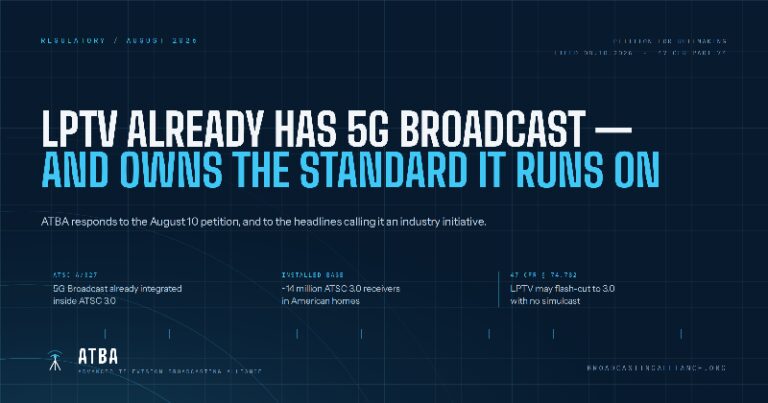
The engineering question is real, and it has an answer: you do not have to choose. In March of this year the ATSC membership approved Amendment No. 1 to Recommended Practice A/327 – “TDM of ATSC with Other Broadcasting Systems” – which describes physical-layer profiles for time-division sharing of a channel between ATSC and other systems, naming LTE-based 5G Broadcast as an example. Castanet is running a pilot network in Las Vegas on that architecture, after an earlier one in Silicon Valley.
Be precise about what that is and is not. It is time-division sharing of the RF channel, not a 5G waveform wrapped inside a 3.0 frame, and a Recommended Practice is guidance rather than a mandate. What it means is that the specification work is finished and published, and a licensee can reach 5G Broadcast devices from broadcast spectrum without anyone amending Part 74 first.
The question that actually matters is architectural. In a shared-channel design, you own the frame. You allocate capacity between services, you decide what the spectrum carries this quarter and next. In a standalone cellular design, the spectrum runs somebody else’s air interface end to end, and the companies with the chipsets and the deployment capital to use it at scale are not LPTV operators.
That is a conversation worth having on the merits. It is not helped by pretending that one private standards body is a public utility and the other is a cabal.
What to do with this
If you are specifying equipment for a 3.0 build this year, ask your exciter and gateway vendors in writing what their roadmap is for A/327 waveform flexibility, and whether the units you are buying are software-upgradable to support it. Most modern exciters are software-defined. It is a fair question to put to GatesAir, Anywave, Televes/TRedess or Rohde & Schwarz, and several of them build for both standards already.
You do not need a 5G Broadcast business case today to want that capability in the chassis. You need it so that when a customer shows up, the answer is a configuration change instead of a capital request.
And when somebody tells you a standard is illegitimate because a private organization wrote it, ask them who wrote the other one.
Not a member yet? Join today at broadcastingalliance.org.
The Advanced Television Broadcasting Alliance is the trade association for the low power television and over-the-top industries. Questions about this article or the petition may be directed to info@broadcastingalliance.org or (877) 214-4277.